History of Coffee in Colombia
As with many coffee origins, it is believed that coffee was first brought to Colombia by priests, arriving, perhaps, within a decade or two after coffee first came to the Americas via the Caribbean in the first half of the 17th century. It was likely a garden crop grown for local consumption and barter for decades. Unlike other coffee regions, we have the story of a priest named Francisco Romero, who could be called the father of commercial coffee cultivation in Colombia. The folkloric tale goes that in the early 1800’s, Father Francisco, hearing confessions in the northeastern town of Salazar de la Palmas, assigned planting coffee to his parishioners as penance for their sins. The Archbishop of Colombia heard about this and ordered all priests to adopt the practice. Commercial production of coffee expanded quickly, moving into regions where the growing conditions were ideal.
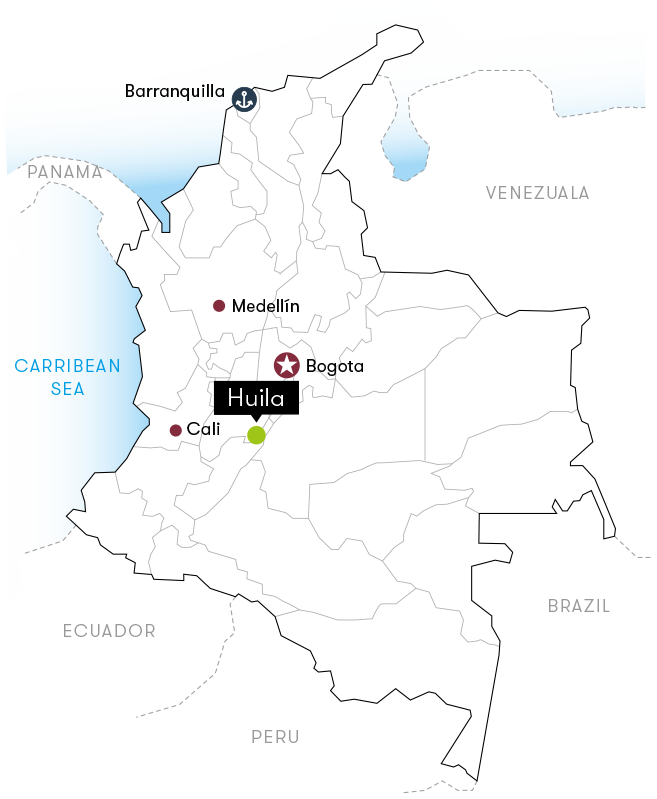
The municipality of Inzá is located in the corner of the Department of Cauca, bordering with Tolima and Huila, and looking out to the west over the Pacific Ocean. Situated on
the “Macizo Colombiano” (the Colombian Plateau), which make up the high peaks of Tolima and Huila, the region is an important source of water and wildlife, in addition to being prime coffee growing land. This coffee was produced by 52 smallholder coffee producers hailing from the neighbouring sub-municipalities of Pedregal and San Antonio. Every single microlot delivered was cupped and reserved due to its scoring 85 points or above by the community cupping lab, funded by Mercanta Exporting Partners, Pergamino, who are based in the Department of Antioquia. These stringent standards result in very limited quantities of this exceptional blend of 70%+ Caturra and approx. 30% Variedad Colombia being made available for export. Cauca’s violent past, with a heavy presence of FARC guerrillas, had historically prevented the FNC (Colombia’s excellent national coffee board) and specialty-focused exporters from establishing a presence in the region. As violence has diminished, it has enabled the growers in the region to seek increased access to markets for quality, not only taking advantage of the region’s wonderful coffeegrowing conditions but also the economic resource that nearby tourist destinations bring (for instance, the World
Heritage Site “Parque Nacional Arqueológico de Tierradentro”). We found out about this coffee through our good friends at Pergamino, who serve it in their own flagship specialty café in Medellin. Like all producers in Colombia, Pergamino spent many years
helplessly riding the roller coaster of international coffee prices. They had to invest, year after year, in their crops without knowing what price they would secure. As the saying
goes in Colombia, there were years of lean cows and years of fat cows – the former being more common than the latter. They often sold their coffee to large exporters, never
understanding its unique sensory coffees, nor in whose hands it ended up for what price. When they began selling their coffee directly to importers and roasters, everything
changed. When they extended the model to small holder farmers in Antioquia, they also changed everything for them.
This coffee is a blend of two lots from our exporting partner in Colombia, Pergamino. Both of these lots are collections from smallholders throughout two different
regions in the country. These coffees were then carefully blended and sent through the Hanseatic Sugarcane EA Decaf process. Further information about each lot and
the decaf process is outlined below
The Process
This lot underwent the Ethyl Acetate decaffeination process at the Coffein Compagnie in Bremen, also known as the Sugarcane Decaf or Natural Decaf Process.
The special EA process preserves the high quality of the green beans, whilst successfully removing the caffeine content. Ethyl acetate occurs naturally in fruits, and this is
why it is the best natural option for decaffeination. For this process, sugars from sugarcane are fermented to create ethyl alcohol. This is then mixed with acetic acid to create ethyl acetate.
The EA decaffeination process begins with a pretreatment steaming the coffee beans at a low pressure to remove the silver skin, or the thin layer of skin on the coffee beans. The
coffee beans are then moistened with hot water to swell and soften, to catalyze the hydrolysis (the chemical breakdown of a substance due to reaction with water) of
the caffeine. Essentially, the caffeine is bonded to chlorogenic acid inside the coffee, and this process breaks them apart to remove the caffeine. The beans are then
moved through an extractor, where they are repeatedly washed with the natural solvent, ethyl acetate. This occurs several times in order to remove 97% of the caffeine content
within the coffee. Surprisingly, the weight of the coffee is reduced by 3%. The
EA method gently extracts the caffeine from the coffee without using excessive heat that may damage the beans. Once this process is complete, a flow of low-pressure steam
is passed over the beans to remove any remaining ethyl acetate, which will evaporate at 70°C once the coffeebeans are roasted.
Lastly, the coffee is vacuum-dried until the moisture content of the coffee is brought back to the original moisture level when it arrived at the EA processing facility – typically
between 10-12%. Thus, completing the dec