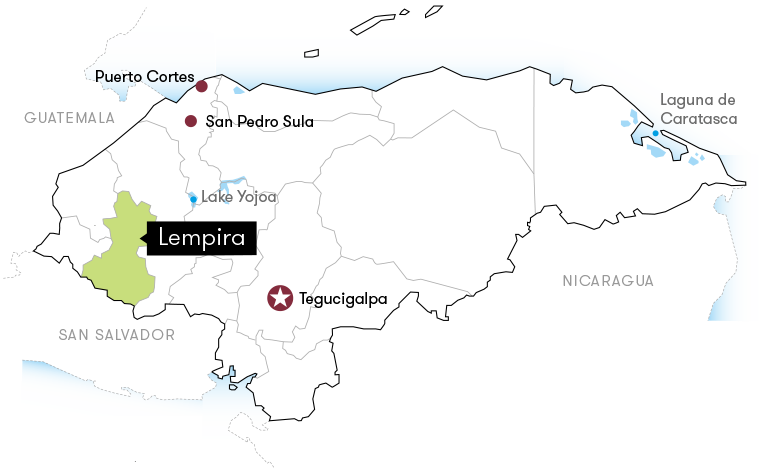
Finca El Aguacatillo is the passion of Alix Yovani Ramírez, who began his coffee journey as a farm labourer before purchasing his first plot in 2005. Today he manages 14ha of coffee in Guinope, producing around 300mt annually. At 1617 meters, his farm grows IHCAFE 90 and Lempira. The washed process involves cherry flotation, 16 hours of dry fermentation, mechanical washing, and solar dome drying for 8–15 days. With depulping done the same day as harvest, El Aguacatillo highlights Alix’s dedication to precision, sustainability, and producing competitive, high-quality Honduran coffee.
History of Coffee in Honduras
Prior to 1900, coffee was essentially a garden crop in Honduras, grown on small lots of land and traded within the country for internal consumption. Less than 10 percent of the coffee harvested was exported in 1894. By 1900, exports had more than doubled, but banana was still king. A decline in banana production over the decades coincided with a slow but steady growth in coffee production. Today, Honduras is the largest coffee producer in Central America, exporting more than 5 million bags last year, and is one of the largest exporters of specialty grade coffee.
Growing Coffee in Honduras
Honduras is somewhat unique in that it experienced the most significant growth in export volume after the emergence of the specialty coffee industry, so new farmers and new mills begin with quality as their goal. Coffee is now pervasive in Honduras, grown in 210 of the 298 municipalities and throughout central and coastal highlands within six districts identified as Coffee Regions. Starting in the north and moving south, the regions are Copan, Opalaca, Montecillos, Comayagua, El Paraiso, and Agalta. More than 60 percent of Honduras coffee is grown above 12 hundred meters and as high as 16 hundred. Almost 90 percent of Honduras coffee is grown on small (less than 153 bags) and medium (between 153 and 766 bags) sized farms. Virtually all Honduras coffee (over 90 percent) is washed and sun dried. Plant varieties include Cautuai, Caturra, Bourbon, Typica, and Pacas.