Ashok Patre is a progressive. Well-travelled and bursting with initiative, he has drawn inspiration from elsewhere to step beyond the boundaries of traditional Indian coffee cultivation and processing. Brix levels are tested before harvesting. Processing includes natural, honey and a growing number of fermentation experiments alongside the traditional washed. In recent years Ashok has invested heavily in laboratory equipment in order to scale his experiments with precision. Such techniques include anaerobic fermentation, carbonic maceration and innoculation with lab-grown yeasts and bacterial cultures.
For all intents and purposes Ratnagiri Estate is an biodynamic farm and also maintains official Rainforest Alliance Certification. Quarterly soil tests and organic corrections to soil are applied. Ionic seawater and sea weed extract are applied to improve plant immunity and sugar levels of the fruit.
The estate is a lush shaded environment with 3 stories of shade. It is home to over 48 recorded bird populations, monkeys, leopards, wild boar, tigers, mongoose and - on occasion - elephants. The rich biodiversity demands that Ashok and his family have an approach to farming which places ecology and harmony with the environment at the forefront. This is a world class farm, truly one of the leading in India and a great example of Olam and the farmer working together to engineer excellence.
History of Coffee in India
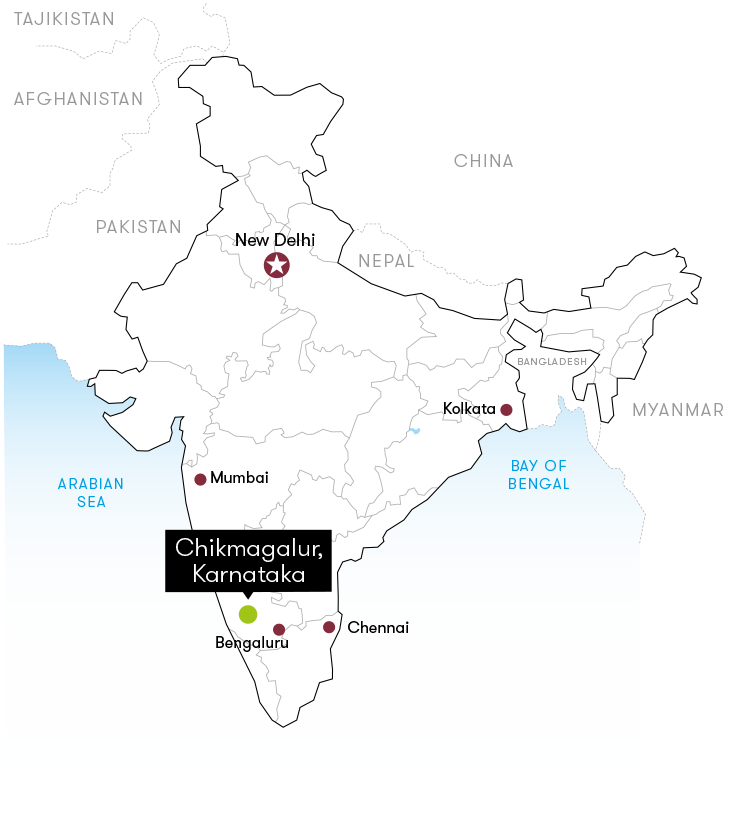
If coffee was born in Ethiopia and grew up in Yemen, then it left home to make its own way in the world through India in the 17th Century, when Baba Budan, returning from a pilgrimage to Mecca, smuggled seven beans and planted them in hills of the Chikkamagaluru district, a hill region now known as Baba Budan Giri. Green coffee cultivation grew slowly in India and the first formal plantations were established by the British in 1840 in the same region where the first coffee was planted.
Over the years, repeated battles with leaf rust and an emphasis on yield caused India to increase planting Robusta and prioritize shade growing conditions. Today, India grows more than twice as much Robusta as Arabica and nearly all coffee is grown under shade, much of it in forest conditions. Over 21% of India’s coffee is exported to Italy, where Robusta has long been a part of traditional espresso blends. In recent years, Olam has been finding coffee for the specialty market. India is poised to attract increasing attention from specialty markets, and not only because quality is quickly improving. Coffee plantations in India are home to abundant wildlife, including tigers and elephants, because of the forest-like conditions. Compared to shade grown coffee in other parts of the world, coffee in India is grown in dense shade conditions, and almost intercropped with peppercorn, cardamom, areca nut, oranges, bananas, and other crops.